
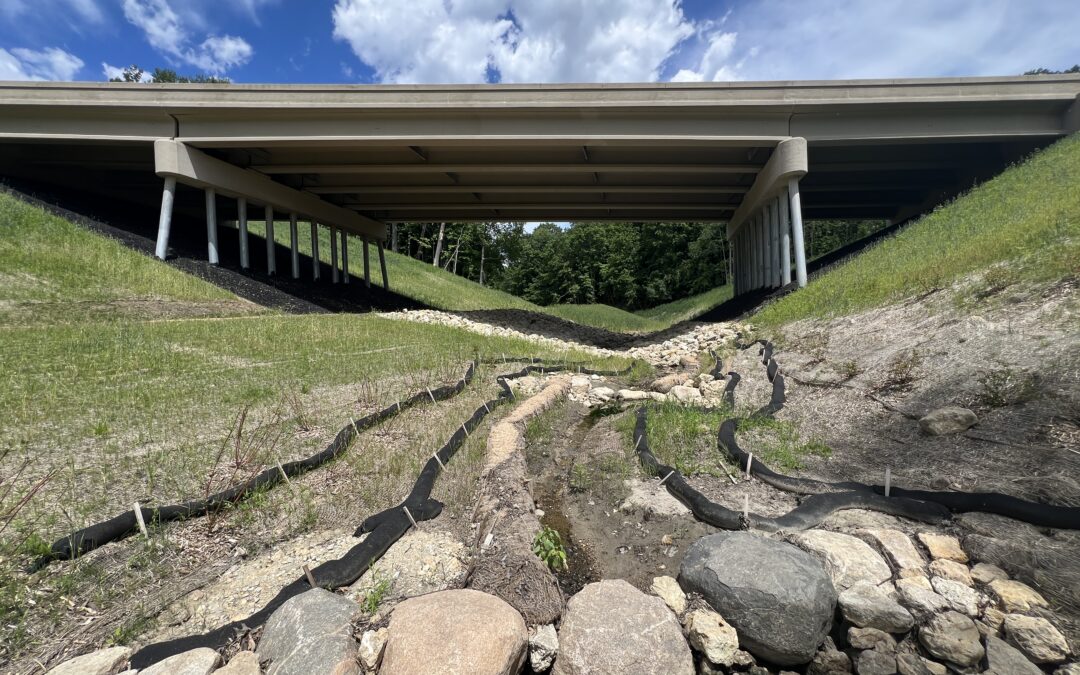
For the first time in over 30 years, East Chaska Creek runs the way it was always meant to – open, alive, and connected to the land around it.
What was once a buried pipe beneath a roadway is now a naturalized stream corridor, complete with riffles, a reconnected floodplain, and a trail that invites people to stop and actually witness a creek doing what creeks do.
This project was especially close to the heart of Midwest Wetland Improvements (MWI) founder Lucius Jonett. His graduate thesis project focused on a redevelopment plan for the Ford Site in St. Paul, starting with restoring the historic Hidden Falls Creek, and then designing the redevelopment around the restored creek. That early work planted a deep appreciation for what it means to give a stream its life back.
So, when the opportunity came to partner with the Carver County Watershed Management Organization (CCWMO) on daylighting this unnamed tributary of East Chaska Creek, it was a natural fit in every sense of the word.
This is the story of how a routine infrastructure project became something a lot more meaningful.
Project Overview
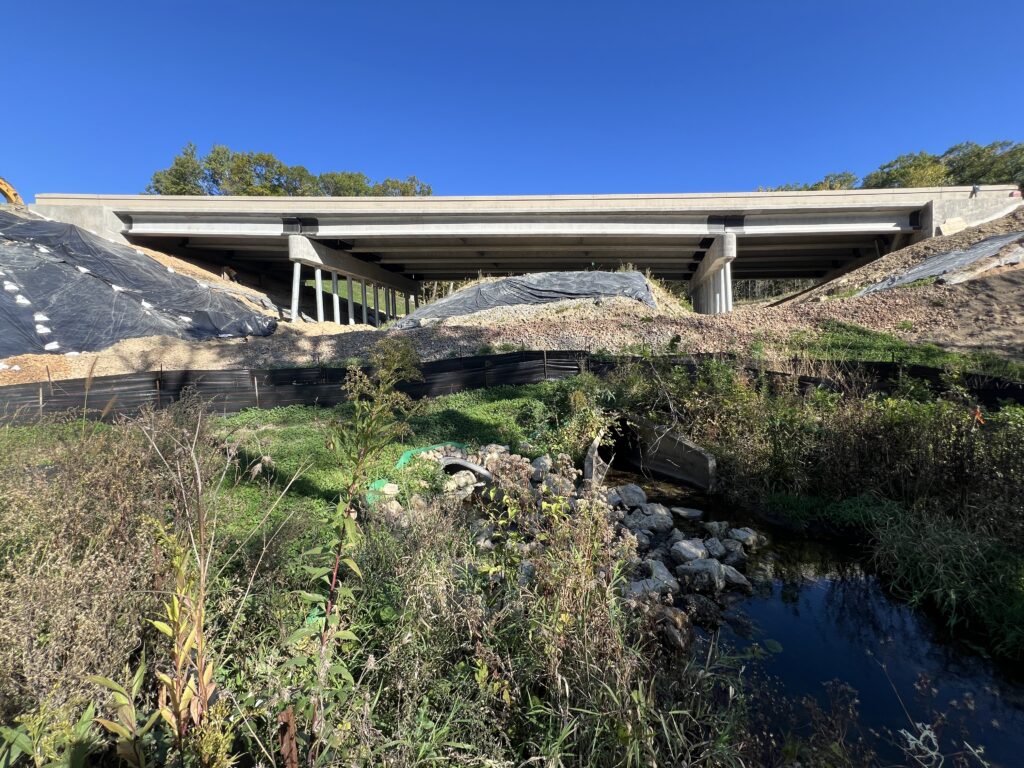
Upper East Chaska Creek drains from the Spring Peeper Meadow wetland complex south to Big Woods Lake. Since the 1990s, a key segment of this creek has been routed through an underground pipe. This setup has disconnected the stream from its floodplain, limiting aquatic habitat and organism passage, and contributing to downstream water-quality concerns.
This project is part of the City of Chaska’s 82nd Street and Lyman Boulevard extension project, which also included a new bridge crossing. The work was coordinated with CCWMO to ensure that transportation infrastructure improvements also advanced watershed-scale ecological and water-quality objectives.
For the first time in more than 30 years, East Chaska Creek now flows through a restored stream corridor rather than a buried conveyance.
Project Goals
CCWMO had multiple goals for this project, including:
- Restoring the historical stream channel through removal of fill and culvert infrastructure
- Daylighting a previously piped stream reach
- Providing floodplain access to improve hydraulic resilience during large storm events
- Stabilizing streambanks and reducing erosion
- Improving aquatic habitat and connectivity
- Reducing nutrient and sediment loading to Big Woods Lake
- Connect people to water with the trail next to the new stream channel.
Approach and Design
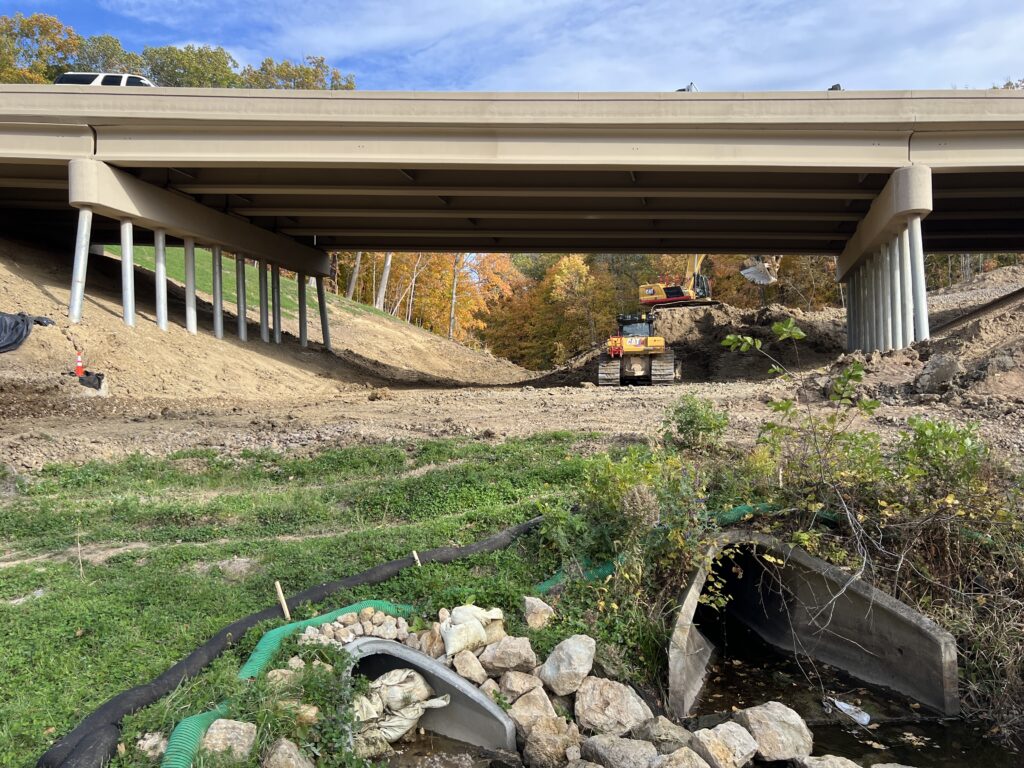
MWI partnered with CCWMO to provide technical review and stream restoration design guidance for a City-led bridge replacement and roadway project that included daylighting a stream reach previously conveyed through a pipe.
Working collaboratively with the City’s bridge design engineer, MWI supported the transition from a buried pipe conveyance to an open, naturalized stream channel that could be seamlessly integrated into the final bridge design. Close coordination ensured that channel geometry, grades, and floodplain elevations aligned with structural, hydraulic, and regulatory requirements.
The design approach incorporated natural stream components, including appropriate channel dimensions, substrate selection, riffle construction, and stable bank treatments. It also accommodated bridge hydraulics and roadway constraints.
This integrated process aligned infrastructure performance with ecological function to create a resilient, long-term solution that serves both transportation and watershed goals.
Construction and Implementation
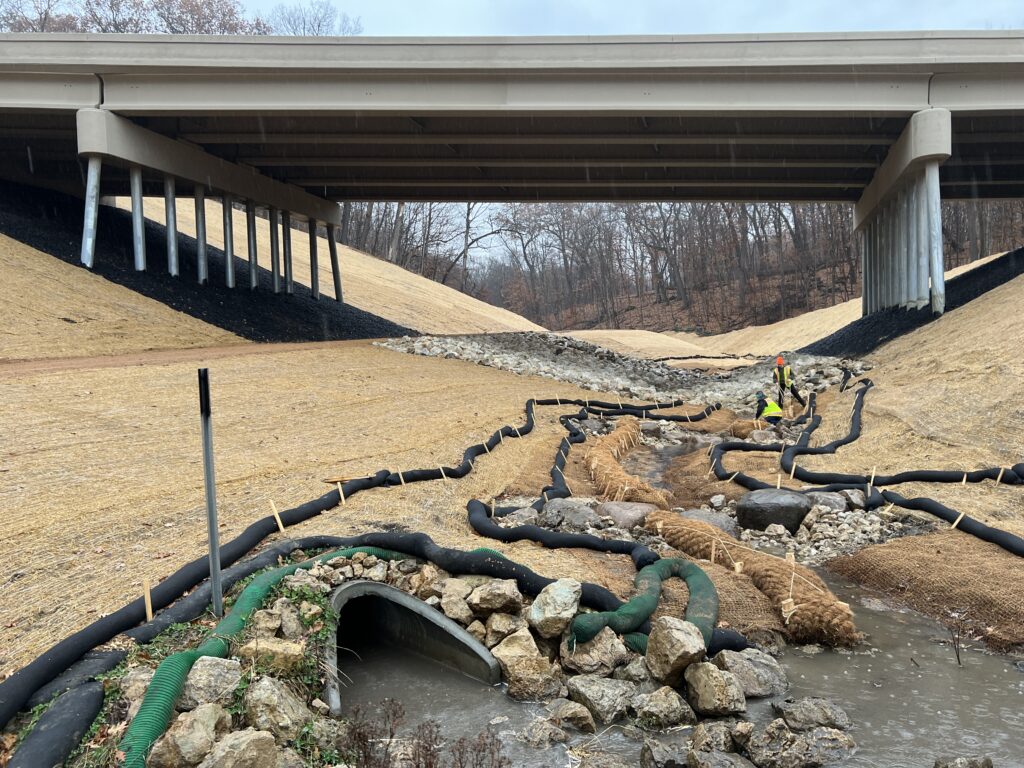
Construction of the stream occurred as the final phase of the bridge project within the broader 82nd Street corridor improvements. The existing pipe was removed, and a new stream bed was constructed as an open channel with floodplain connectivity.
During construction, flows were bypassed, but during final implementation, flows were redirected into the restored channel. This marked the first time in decades that water flowed through this reach in a natural setting.
Outcomes
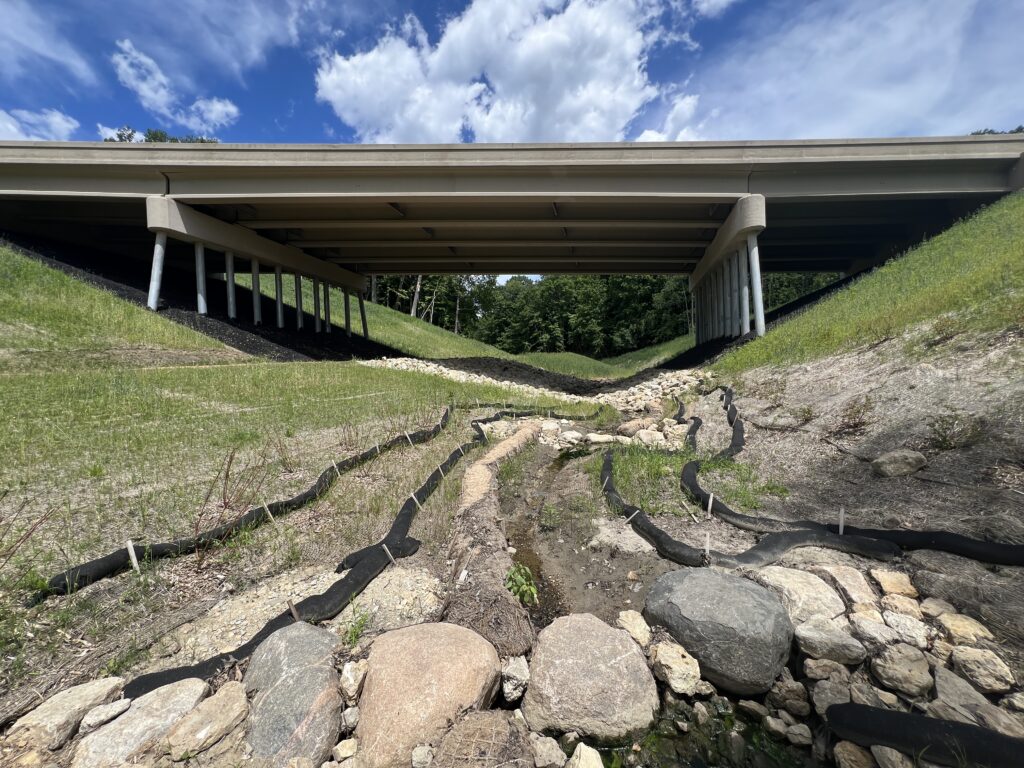
By the end of construction, East Chaska Creek had been transformed from a buried pipe into a functioning, living stream. Here’s what that meant on the ground:
- 450 linear feet of stream daylighted and restored
- Underground pipe removed
- Floodplain reconnected to provide storage and attenuation during larger storm events
- 10 constructed riffle features installed to improve oxygenation and aquatic habitat
- Streambanks stabilized to reduce erosion
- Aquatic wildlife habitat restored
- Nutrient pollution to Big Woods Lake reduced
The stream daylighting project was supported by a $180,000 grant from the Minnesota Board of Water & Soil Resources (BWSR) administered through CCWMO. The success of this project demonstrates the value of coordinating state, county, and municipal investments to achieve multiple goals within a large infrastructure project
Lessons Learned
The East Chaska Creek project reinforced the value of early and continuous coordination between bridge engineers and stream restoration specialists. Integrating daylighted channels into bridge designs is most effective when hydraulic, geomorphic, and structural considerations are addressed together rather than sequentially.
The project also demonstrated that roadway projects can serve as powerful opportunities for meaningful ecological restoration when watershed goals are intentionally embedded into infrastructure design.
Long-Term Environmental Impact
The restored reach of East Chaska Creek will continue to provide long-term benefits by:
- Supporting stable channel processes and reduced maintenance needs
- Improving resilience to larger storm events through floodplain storage
- Enhancing aquatic habitat connectivity
- Reducing sediment and nutrient delivery to Big Woods Lake
- Serving as a demonstration project for integrating stream restoration with transportation infrastructure
Monitoring & Performance Data
To monitor changes in the stream as it matures over the next decade, CCWMO Staff plans to conduct upstream and downstream sampling and ongoing stream survey work.
Fish surveys will occur in 2026 and within the next five years to document changes in the fish community.
Carver County Watershed Management Organization’s Perspective on the Project and Its Outcome
Thanks to Midwest Wetland Improvements’ knowledge of natural stream geomorphology and their construction oversight experience, the outcome of this project far exceeded expectations.
MWI worked through the bridge design firm to deliver a plan set designed to CCWMO’s specific standards, which was incorporated into the larger bridge project. They also oversaw the project’s construction, serving as the on-the-ground point person to both answer questions under the contract and correct mistakes as they arose.
MWI’s hands-on approach allowed for corrections in the field before they multiplied into large problems later on, after the contractor was off-site. The knowledge and experience that they drew upon during plan set development and construction oversight ensured that the project would be a long-term success. CCWMO is looking forward to working with MWI again.
Want to Follow Projects Like This One?
East Chaska Creek is one example of what becomes possible when watershed goals are built into infrastructure from the very beginning and not bolted on afterward. It’s a model we’re proud of and one we hope to see replicated across more communities in the region.
If you want to stay up to date on projects, insights, and restoration work from the Midwest Wetland Improvements team, sign up for our newsletter. We share the kind of behind-the-scenes perspective you won’t find anywhere else, because the work of restoring wetlands and streams is too good a story to keep to ourselves.
Recent Comments